


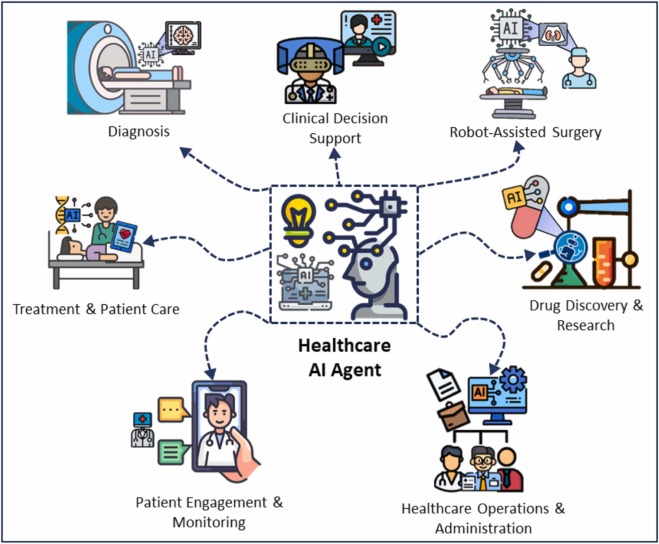
Three of the most consequential sectors in the American economy, healthcare, finance, and legal services, are also three of the most heavily regulated, most data-sensitive, and most resistant to change. They are also three of the sectors where agentic AI is currently delivering some of its most transformative results. Understanding how agentic AI is being applied specifically within each of these sectors, what is working, what the constraints are, and what the realistic near-term trajectory looks like, gives you a much clearer picture of where this technology is genuinely headed in the real world.
Why These Three Sectors Matter Most
Healthcare, finance, and legal services collectively represent a massive share of U.S. GDP and employ tens of millions of Americans. They are also sectors where inefficiency is extraordinarily costly, not just financially but in human terms. A delayed insurance authorization can affect a patient’s treatment. A compliance failure in financial services can result in regulatory penalties and customer harm. An error in legal document review can have consequences that ripple through years of litigation or business relationships.
The combination of high stakes, high volume, and high complexity that characterizes these sectors makes them both the most challenging environment for agentic AI and the environment where getting it right delivers the most significant value. The organizations that are succeeding with agentic AI solutions in these sectors are demonstrating that the technology is mature enough for serious deployment even in the most demanding professional contexts.
Healthcare: Transforming Administration Without Compromising Care
The single biggest opportunity for agentic AI in healthcare right now is administrative workflow automation. The administrative burden in American healthcare is extraordinary by any measure. Physicians spend an average of 4.5 hours per day on administrative tasks according to a 2025 American Medical Association study, time that is not being spent on patient care and that contributes significantly to the burnout crisis affecting the clinical workforce.
Prior authorization is one of the most time-consuming and frustrating administrative processes in healthcare, for providers and patients alike. An agentic system handling prior authorization can gather the required clinical documentation, check it against payer criteria, complete the submission, monitor the response, handle denials through the appeals process, and communicate status updates to the relevant clinical staff, all autonomously. Health systems that have deployed agentic prior authorization systems report reducing the average time from 72 hours to under 4 hours for standard cases, with staff time per case dropping from 45 minutes to under 5 minutes of oversight.
Medical coding and billing represents another high-impact area. Agentic AI data solutions in healthcare revenue cycle management can read clinical documentation, assign the appropriate diagnostic and procedure codes, check for common errors and compliance issues, submit claims, monitor adjudication, and manage the denial and appeal workflow. A regional hospital network reported that agentic coding assistance reduced coding errors by 67% and accelerated their revenue cycle by an average of eleven days, a meaningful cash flow impact for any healthcare organization.
Patient communication and care coordination workflows are also being transformed. An agentic system can handle appointment reminders, post-visit follow-up, medication adherence outreach, and care gap notifications across a large patient population simultaneously, with personalization and consistency that human care coordinators cannot match at scale. A federally qualified health center deployed an agentic patient outreach system that increased their preventive care completion rates by 34% within twelve months, a significant population health impact achieved without adding clinical staff.
The boundaries that agentic AI in healthcare must respect are clear and important. Clinical decision-making, diagnosis, and treatment planning remain firmly in the domain of licensed clinical professionals. The regulatory framework around HIPAA requires robust data handling and access controls. And the stakes of errors in clinical contexts demand human oversight mechanisms that are more stringent than in most other industries. The organizations succeeding in this space design their systems with these boundaries clearly defined from the start rather than treating them as constraints to work around.
Finance: From Back Office Automation to Intelligent Risk Management
Financial services organizations were among the earliest enterprise adopters of automation broadly and are now among the most sophisticated deployers of agentic AI solutions for enterprises. The combination of structured data, high transaction volume, clear rule sets, and enormous cost pressure in back-office operations creates a near-ideal environment for agentic automation.
Trade operations and settlement is one area where agentic AI is delivering immediate impact. The manual processes involved in trade confirmation, exception management, and settlement instruction handling are high-volume, time-sensitive, and error-prone when handled by fatigued human operators under deadline pressure. Agentic systems handling these workflows operate continuously without fatigue, apply rules consistently, and escalate genuine exceptions to human operators rather than creating new ones. A mid-sized asset manager deployed an agentic trade operations system that reduced settlement fails by 58% and cut operations headcount requirements by 30% within the first year.
Compliance monitoring is another high-value application. Financial services firms face an ever-expanding regulatory landscape that requires continuous monitoring of transactions, communications, and business activities against an evolving set of rules. Agentic AI services and solutions in compliance can monitor trading activity for potential market manipulation patterns, review communications for policy violations, track regulatory reporting deadlines, and generate the documentation required for examinations, operating continuously across the full scope of a firm’s activities rather than sampling a fraction of it as human review teams inevitably must.
Loan origination and credit decisioning workflows are being transformed by agentic AI in ways that simultaneously improve efficiency and enhance fairness when designed well. An agentic origination system can gather and verify applicant information from multiple sources, check it against underwriting criteria, identify gaps or inconsistencies that need clarification, generate preliminary decisions with full documentation, and route files requiring judgment to the appropriate human underwriter with a complete analysis already prepared. Community banks and credit unions are finding that agentic loan processing allows them to compete with larger institutions on speed and convenience without sacrificing the personalized service that differentiates them.
Fraud detection has long been a domain where machine learning has been applied, but agentic AI takes this further by enabling active investigation rather than just flagging. When a transaction is flagged as potentially fraudulent, an agentic investigation system can gather additional context from account history, cross-reference with known fraud patterns, assess the likelihood of genuine fraud versus false positive, and either block the transaction or clear it for processing, all in milliseconds. Agentic AI data solutions in fraud management have shown average false positive reduction of 40% in early enterprise deployments, which translates directly into fewer frustrated customers and lower investigation costs.
The regulatory environment in financial services requires particular attention to model explainability, audit trails, and fair lending compliance. Any agentic system making or influencing credit decisions must be able to produce clear documentation of the factors that drove each decision. Organizations that build this explainability into their systems from the beginning avoid the much more painful process of retrofitting it when regulators come asking.
Legal Services: Augmenting Professional Judgment at Scale
Legal services present a distinctive set of opportunities and constraints for agentic AI. The constraints come primarily from professional responsibility rules that place clear limits on what can be delegated to automated systems and from the complexity and contextual nature of legal reasoning that makes full automation of legal judgment genuinely inappropriate rather than just technically challenging.
The opportunities come from the enormous volume of time that legal professionals spend on tasks that are information-intensive and process-driven rather than requiring the kind of legal judgment that justifies attorney billing rates. Document review in litigation is the canonical example. Large cases can involve millions of documents that must be reviewed for relevance and privilege before production. Agentic document review systems can process these volumes at speeds no human team can match, applying consistent criteria across the entire document set, flagging privileged materials, identifying the most relevant documents for attorney attention, and producing a structured review output that human attorneys can work from efficiently.
Contract analysis and management is another high-impact area. Agentic AI for localization principles apply here as well, with systems that can review contracts in multiple languages and adapt their analysis for jurisdiction-specific legal requirements. An agentic contract review system can extract key terms, identify non-standard provisions, flag potential risks against a defined risk library, compare terms against playbook positions, and generate a structured summary that gives attorneys an immediate picture of where their attention is most needed. Law firms and corporate legal departments report that agentic contract review reduces average review time by 60 to 70% while improving consistency and coverage.
Legal research is being transformed by agentic systems that can conduct comprehensive case law searches, synthesize relevant precedents, identify contrary authority, and produce structured research memoranda that attorneys can review and build on rather than starting from scratch. The most effective deployments treat the agentic research output as a thoroughly prepared first draft that the attorney then applies their professional judgment to, rather than as a finished product.
Compliance and regulatory monitoring is an area where corporate legal departments are finding particular value. The volume of regulatory change across federal, state, and international jurisdictions that large organizations must track and assess for applicability has outpaced the capacity of traditional legal team structures. Agentic AI solutions for enterprises in legal and compliance functions can monitor regulatory developments continuously, assess their applicability to the organization’s specific activities, generate impact analyses, and alert the relevant stakeholders, ensuring that nothing significant falls through the cracks regardless of how much regulatory activity is occurring simultaneously.
The professional responsibility boundaries that agentic AI must respect in legal services are non-negotiable. Attorneys remain responsible for the legal advice they give, the arguments they make, and the judgments they exercise. Agentic systems that support legal work must be designed clearly as tools that augment attorney capability rather than as systems that independently exercise legal judgment. The organizations deploying agentic AI in legal services most effectively are those that have thought through these boundaries carefully and built their systems to operate clearly within them.
Cross-Sector Observations
Looking across all three sectors, a few consistent patterns emerge in the deployments that are delivering the best results. The most successful implementations start with workflows that are high-volume, well-defined, and data-rich rather than trying to tackle the most complex and judgment-intensive processes first. They invest heavily in data quality and system integration before deploying, recognizing that agentic systems are only as good as the information they work from. They build robust human oversight mechanisms that are proportionate to the stakes involved. And they measure outcomes rigorously from the beginning, using real performance data to guide expansion decisions rather than relying on theoretical projections.
The organizations struggling with agentic AI in these sectors tend to share the opposite characteristics. They underestimate the data preparation work required. They deploy with insufficient human oversight and then overcorrect after an incident. They try to automate too much too quickly before establishing confidence in the system’s behavior in their specific environment.
Conclusion
Healthcare, finance, and legal services are not the easiest environments to deploy agentic AI, but they are among the environments where getting it right matters most and delivers the greatest value. The evidence from organizations that have made serious investments in sector-specific agentic solutions is clear: the technology works, the ROI is real, and the operational improvements are transformative when implementation is approached with the rigor these sectors demand. The question for leaders in these industries is no longer whether agentic AI belongs in their operations. It is how to build the organizational capability to deploy it responsibly and effectively across the workflows where it can make the biggest difference.
