


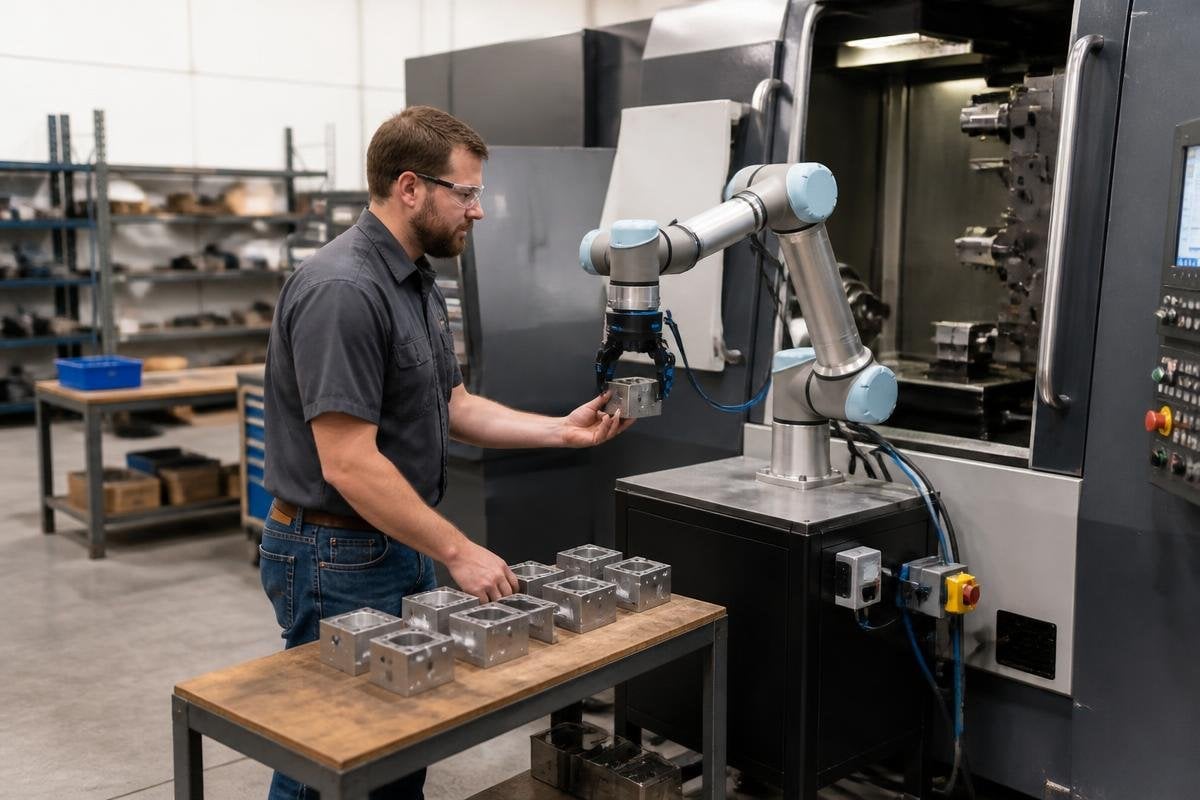
Small manufacturers are buying robots for ordinary factory problems: repeated handling, uneven output, and difficulty filling open shifts. The machines now fit more work because many can be moved between tasks instead of being fixed to one production line.
- Robots take on repeat tasks that wear people down
- Smaller cells need less floor space and setup work
- The main test is payback, not novelty
The job comes before the robot
A robot makes sense when the task repeats, follows clear steps, and has a known handoff. Loading a machine, moving parts between stations, or placing the same item in a fixture can fit that pattern.
The work still needs a person to define the limits. They must check part size, weight, grip points, cycle time, and the space around the cell. One that handles a part well may struggle when a supplier changes its shape by a few millimeters.
That detail matters more in a small plant because one failed cell can affect a large share of daily output. A larger factory may have another line to absorb the delay. A small shop may not.
Why the cost now looks easier to manage
Small manufacturers often need equipment that can start with one task and move later. A collaborative robot, or cobot, can work near people when the full cell meets the required safety rules. Its arm may move between fixtures, while a technician changes the tooling for a new part.
That flexibility changes the buying decision. The owner can judge one work cell, one product family, and one shift instead of planning a full factory project.
The robot still needs more than the arm. The cell may need a gripper, fixture, camera, safety scanner, controller, and software.
Installation, training, maintenance, and part changes belong in the cost too. A low arm price can hide a high finished-cell price.
A small-factory owner can use Robot24.com robotics coverage to place machine prices beside named deployments and reported tasks. The limits still matter when installation, training, maintenance, and part changes enter the bill.
The limits are still plain to see
Robots handle repeatable motion well. They are less comfortable with loose parts, changing surfaces, poor lighting, and tasks that depend on touch. A person may sort a mixed bin without thinking. A robot may need a new gripper, a camera, and software changes for each part type.
Safety adds another layer. A cobot’s speed and force limits do not remove the need for a risk check. The whole cell matters, including sharp tools, stored energy, pinch points, and what happens after a sensor fails.
Data can also expose a weak project. The plant needs a record of cycle time, stoppages, scrap, changeover time, and human work around the robot. Without those numbers, the owner can’t tell if the cell reduced work or moved it to another station.
I’d skip a robot project when the task changes too often to describe in clear steps.
A buying check for a small plant
Use this list before asking for quotes. Each answer should come from the actual workstation, not a product brochure.
- Name the task: Write down the part, motion, handoff, and current cycle time.
- Check the variation: List every part size, surface, package, and changeover.
- Measure the cell: Mark floor space, reach, access points, and operator position.
- Price the full setup: Add tooling, fixtures, safety equipment, software, training, and service.
- Set a stop rule: Decide which downtime, defect rate, or payback result ends the project.
The first purchase should solve a narrow production problem that the plant can measure each shift. A small manufacturer doesn’t need a robot that can do everything; it needs one cell with a clear job, known limits, and a result that still makes sense after the sales demo ends.
